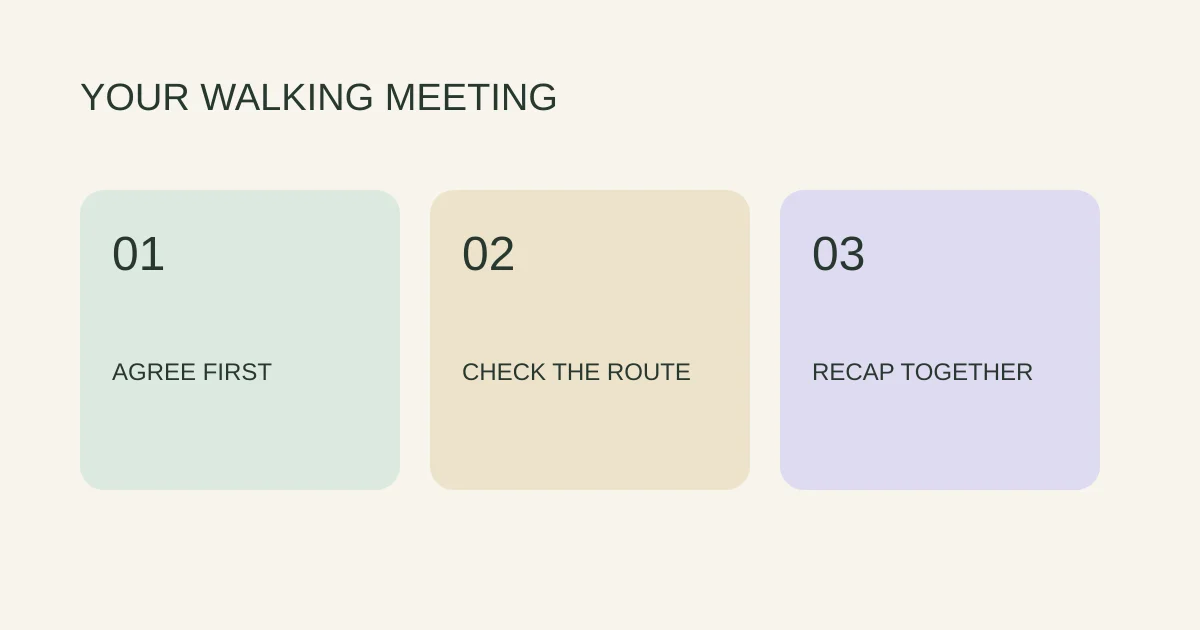
Choose the conversation before choosing the route
A simple check-in or early-stage discussion may need little more than listening and speaking. A spreadsheet review, software demonstration or detailed editing session needs a different setting. Do not move a screen-dependent meeting outside and expect people to follow material they cannot see.
Ask three questions: Can we discuss the agenda without reading? Can everyone participate comfortably? Can we protect the information being discussed? If any answer is no, keep a suitable stationary meeting. A short walk before or afterward is a separate option; our walking-break guide covers those pauses. A walking meeting remains work, not automatically a rest break.
Make the format genuinely optional
The Canada School of Public Service’s walking-meeting job aid recommends checking participants’ preferences and considering whether the meeting fits the format. Ask before sending a walking invitation, not after everyone arrives in unsuitable shoes.
Offer a stationary alternative without requiring anyone to explain a disability, health condition or personal reason. For a shared route, consider wheeling access, places to rest, hearing needs and a pace that permits conversation. Do not leave a colleague behind or make important decisions in a subgroup that they cannot join.
An invitation could say: “Would a short walk suit this check-in? We can use our usual room instead. Either is fine.” Follow workplace arrangements and obtain any required supervisor agreement.
Plan a route and a usable backup
Idaho’s employee-wellness toolkit advises advance notice, a clear agenda, a planned route and a backup. It also recommends small groups and attention to participants’ mobility needs. Start with a modest conversation rather than relocating a large team meeting.
Account for the entire trip, including coats, lifts and returning to the workspace. Check surfaces, lighting, crossings and places where the group would block others. In Canadian winter conditions, ice or poor visibility can make the indoor alternative the better choice. Bad weather is not a commitment test.
A quiet-looking route is not necessarily private. Keep confidential personnel, customer or financial discussions in an appropriate private setting. Passing strangers should not become unintended listeners.
Treat remote audio as an option, not a default
Aalto University’s remote-meeting guidance describes phone-based walking discussions and cautions against unsafe traffic routes and slippery conditions. For your team, agree that audio-only participation is appropriate before anyone leaves their screen.
Check whether captions, interpretation, visual information or another access need requires a different setup. People should be able to remain seated without losing participation. Test ordinary audio quality beforehand, and do not rely on a weak connection for an important decision.
Keep attention available for your surroundings. Stop in a safe place before reading, typing or adjusting controls. If noise, traffic or a new screen-sharing requirement makes the call unsuitable, return to a stationary setting. Do not keep walking merely to complete a planned route.
Finish stationary and capture what was agreed
Reserve the end of the meeting for a stationary recap. Confirm decisions, unresolved questions, owners and next steps while everyone can hear and correct the summary. Then record the agreed result in your normal approved work system.
Do not assume a pleasant conversation produced the same understanding for both people. For example, “We discussed changing the onboarding email” is not the same as “Alex will draft an alternative for review on Thursday.” Distinguish an idea from a commitment.
Recording or adding an automated transcription service is a separate decision, not an implied part of a walking invitation. Use only arrangements permitted by your organization and agreed with participants. Protect time for this wrap-up rather than consuming the next meeting’s buffer; see our between-meetings guide.
Judge the format without promising better results
A walking-meeting pilot published in Preventing Chronic Disease followed a small university-worker sample through one baseline week and two intervention weeks. Seventeen participants contributed to the analysis. The format was feasible and acceptable for that selected group, but measured activity increases on meeting days were not statistically significant.
The authors explicitly say the descriptive study was not designed to determine cause and effect. It does not prove that walking meetings improve your productivity, treat symptoms or suit every worker. Try the format only where appropriate, then ask whether people could participate and whether the meeting achieved its purpose.
Moov can remind you to take movement breaks during desk work; it does not organize walking meetings or grant permission to leave a call. Keep the meeting decision separate from the reminder.
Make room for a movement break
Moov offers configurable break intervals, manual pause/resume and six guided standing movements on Apple Silicon Macs running macOS 11.0 or later. First-run practice requires a camera-checked repetition. It is a movement reminder, not an ergonomic assessment or a treatment for symptoms.
Two free guest breaks, then sign in and verify your email for a seven-day trial. No card required. A paid plan is needed afterward. Read the setup and camera details before trying it.