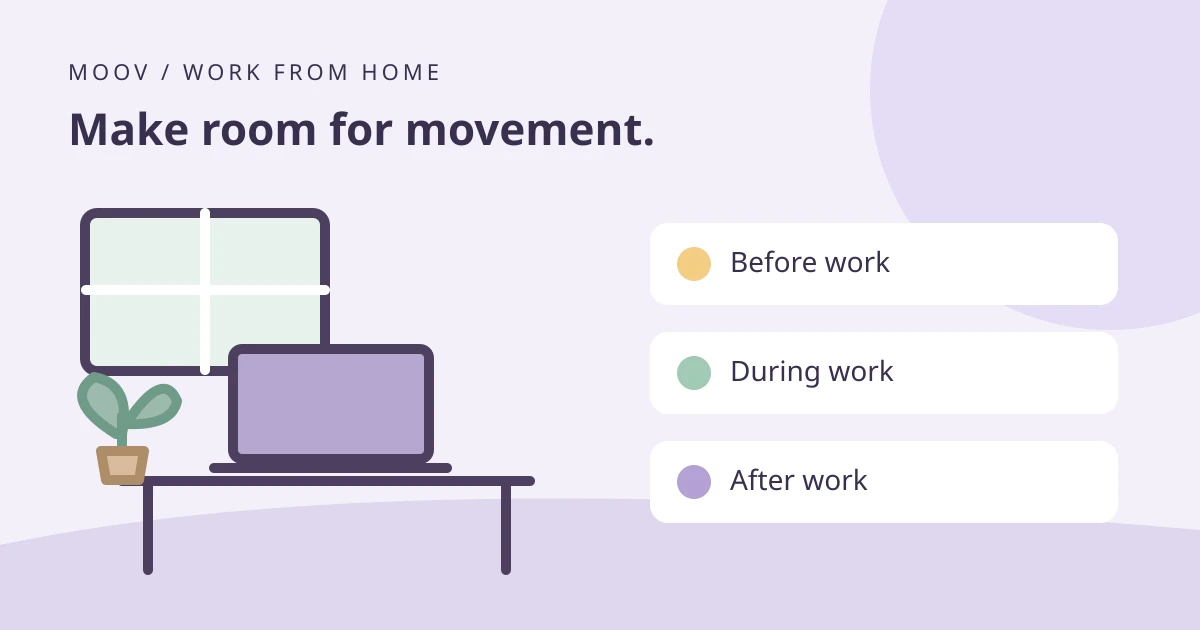
The useful question is not “How can I move every minute?” It is “Where can movement fit into the day I actually have?”
Notice what changed when your commute disappeared
Working from home can remove the walk to a station, trips between meeting rooms or a lunchtime errand. Your circumstances may be different, so look at your own day rather than assuming every remote worker has the same problem.
The Canadian Centre for Occupational Health and Safety points out that natural office breaks may be missing at home. Recreating a few of those opportunities is a practical place to start.
Think about three parts of yesterday:
- Before work: Did you move between getting up and opening your laptop?
- During work: Which tasks kept you in one place? Where was there a real opening to step away?
- After work: Did you finish at a clear time, or keep checking your computer through the evening?
Choose one gap to change first. You do not need to redesign your entire day.
Keep movement breaks and exercise in your plan
Changing position, taking a short walk and doing a workout are different activities. You do not need to choose just one.
Changing from sitting to standing gives you a different position. A movement break might involve walking, wheeling or another familiar activity that suits your mobility. Exercise is activity you plan for fitness, such as swimming, cycling or strength training.
The World Health Organization includes movement during work, transport, leisure and household tasks in physical activity. Its guidance also addresses reducing sedentary time. A few stretch reminders do not, by themselves, establish that you are getting all the activity you need.
For a wider view, the Canadian 24-Hour Movement Guidelines bring together activity, sedentary time and sleep. The linked guidance is for adults aged 18–64 and notes when individual or condition-specific advice may be needed.
Choose a workday plan that fits your schedule
These examples are planning ideas, not medical targets. Adjust the activities and timing to your duties, abilities and any clinical advice you have received.
If your day has long blocks of focused work
Before logging in, use a little of the time you once spent commuting for an activity you enjoy. That could be a short walk, wheeling outdoors on a suitable route or some comfortable indoor movement. The NHS working-from-home guide suggests giving former commute time a deliberate place in your routine.
During work, identify opportunities to leave the screen. A trip to refill your water can include a short walk around your home rather than an immediate return to the chair. At lunch, keep time to eat and, if your break allows, add an activity away from your workstation.
After work, close the laptop at your intended finish time. If exercise is part of your plan, give it its own space rather than expecting a few desk breaks to replace it.
If your day is full of calls
Separate calls that need your screen from conversations that do not. Presentations, detailed notes and document reviews may require you to stay at your workstation. An audio-only conversation might allow some movement, if your responsibilities and surroundings make that appropriate.
For a suitable call, use a clear, safe space and stay attentive. Do not walk somewhere that exposes a confidential conversation, requires you to navigate hazards or makes it difficult to participate. If moving during the call is not practical, use an available gap before or afterward instead.
When every gap is already occupied, the problem is the schedule. Ask the person responsible for meeting times or coverage about workable breaks. A reminder cannot create time that you are not allowed to take.
For help with cues, delayed breaks and meetings, use our separate guide to remembering to take breaks at work.
Have an indoor option ready
Bad weather, a small home or limited time can make an outdoor walk impractical. Choose an alternative you can use without rearranging the room each time:
- Walk or wheel along a clear indoor route, if suitable for you.
- Step away from the screen and use familiar, comfortable movements that fit your mobility.
- Use a brief household task that involves movement during an appropriate break, without turning the whole break into another workload.
- If space or mobility is limited, follow movement options you already know are suitable, including seated options where appropriate.
Keep floors and routes clear. You do not need stairs, a large room or a walking pad to begin. Stop an activity that causes pain rather than trying to finish a repetition count.
If you want specific stretching ideas, see our desk stretches for the lower back guide. That is a separate choice from how you organize your workday.
Decide whether equipment solves your actual problem
A walking pad or adjustable desk may suit some people, but it is not a prerequisite for adding activity. Before buying anything, consider the task you would use it for, your available space and whether you are comfortable using it.
If the main problem is an uninterrupted calendar, equipment will not fix the calendar. If you already have equipment but rarely use it, look at when it could fit before buying more.
Standing also is not the same activity as walking. Our standing desk versus sitting guide explains that distinction without treating either position as something to maintain all day.
Use your Mac to support the plan
A simple calendar reminder or timer can help bring your planned movement break back to your attention while you work. Start with an action you can actually take, rather than installing several competing reminders.
The UK Health and Safety Executive advises short, frequent breaks from display-screen work, with timing suited to the task. It also explains that break software does not replace proper work planning. This is workplace guidance, not a universal medical schedule.
Moov is a movement-break reminder for Mac. If that is the kind of support you want, compare what to look for in a Mac break reminder or Download Moov.
For your next workday, choose one before-or-after-work activity and one realistic opportunity to move during work. Keep the plan small enough to use, then adapt it to what your day allows.